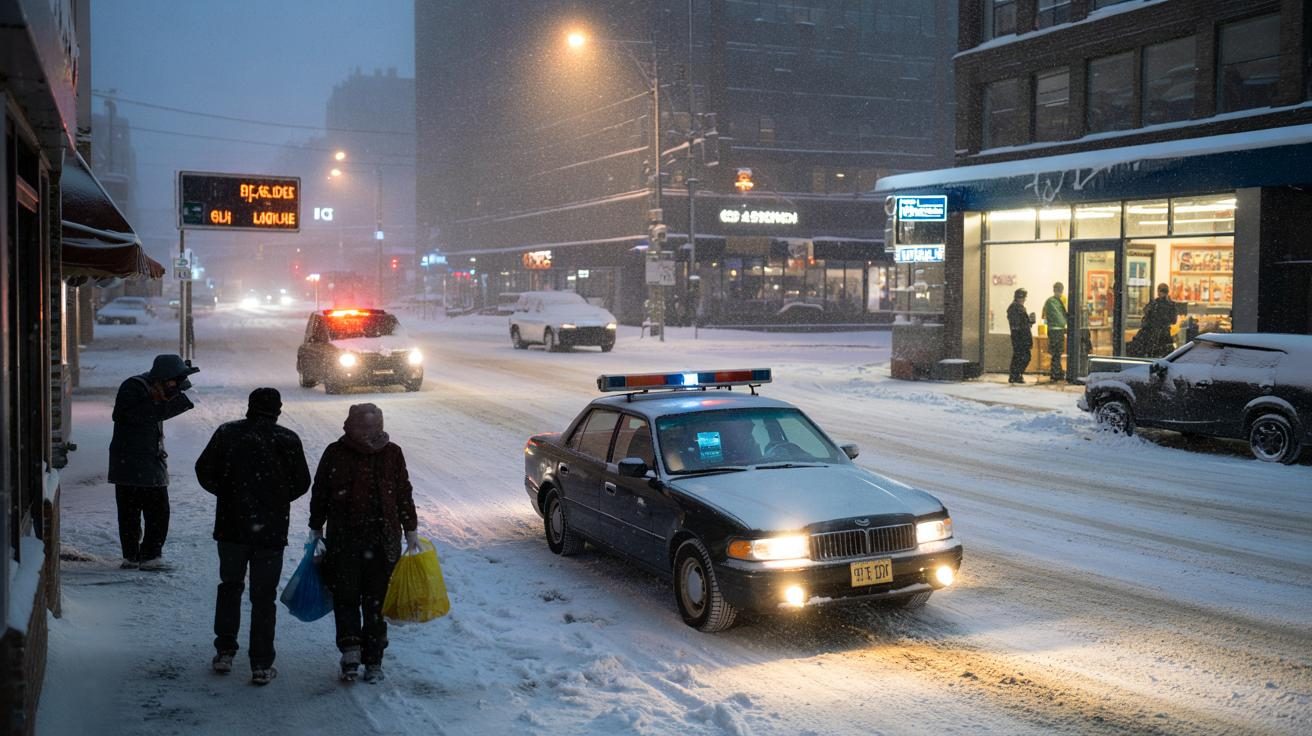
Around 4:45 p.m., the first fat flakes start to drift down, the kind that move slowly, like they’re thinking about whether to commit. The sky over the supermarket parking lot is already a flat, heavy gray. People are hustling out with groceries, one hand on the cart, the other gripping their phones, scrolling through weather alerts and group chats.
Near the exit, a city worker in a neon vest is taping a fresh notice to the glass: “Travel strongly discouraged after 9 p.m.” Ten steps away, a café chalkboard sign still reads: “Open late tonight!”
Two messages. One street.
You can feel the tension settling in with the snow.
Storm warnings clash with business-as-usual pressure
By early evening, the alerts are everywhere. Push notifications, highway billboards, local TV crawls: heavy snow expected tonight, hazardous driving, stay off the roads unless absolutely necessary. The language from officials is blunt and unusually direct.
At the same time, inboxes are filling with a different kind of message. Company emails promising “regular hours,” managers reminding staff they’re still expected in, restaurants gently begging locals not to cancel reservations. Two realities, side by side, both sounding urgent in their own way.
Somewhere between those notifications, regular people are trying to decide what to do with their car keys.
On the city’s north side, delivery driver Mariah is finishing her sixth stop of the afternoon. She pulls up a photo from last winter: her sedan sideways in a snowbank, hazard lights flashing, pizza boxes on the passenger seat. That night, she got home at 2 a.m., exhausted and shaking.
This year she promised herself things would be different. Yet her app is lighting up, orders stacking, a bonus for “high demand weather conditions” dangling on the screen. Across town, a small gym has put out a social media post: “Snow or shine, your goals don’t stop.” Underneath, someone comments, “Buses will be suspended after 8. How are we meant to get there?”
It’s not just about snow totals. It’s about who gets to say no.
City officials talk about “non-essential travel,” but that phrase lands differently depending on whether you’re salaried, hourly, or self-employed. For a commuter with remote-work privileges, staying home feels like the obvious, responsible move. For a barista whose rent depends on tonight’s tips, the moral clarity gets fuzzier.
Authorities focus on reducing accidents, gridlock, and emergency calls. Businesses focus on survival after years of economic shocks. Both arguments are real. Both can be right and still collide on the same icy road.
The storm turns into a spotlight, exposing all the tiny compromises we’ve baked into daily life.
How to navigate the “stay home” message when you can’t just stay home
If your phone is screaming “Do not drive” and your boss is texting “We still need you,” the first quiet step is to map your real options. Not your ideal ones. The ones you actually have between now and midnight.
Start with the basics: distance, timing, and backup. Could you shift your shift earlier and leave before the heaviest band hits? Can you carpool with a coworker who has a safer vehicle? Is there a bus or train still running along part of your route?
Then walk through the drive in your head, street by street. Where does it usually flood, freeze, or clog up on a normal day? Tonight, those are your danger zones.
We’ve all been there, that moment when you feel guilty for even thinking of calling out. You don’t want to be the “difficult” one or the person who “can’t handle a little snow.” The pressure to be loyal to a job, especially in tight times, can drown out your own judgment.
This is where small, unglamorous prep comes in. Keep a winter kit in your car: scraper, blanket, charger, snacks, a shovel if you can swing it. Check your tires before the first storm of the season, not after you’re already sliding through a light. Let’s be honest: nobody really does this every single day. But doing it once, now, could change how tonight plays out.
Sometimes safety is less about bravery and more about boring, tiny choices made an hour earlier.
“People think of storms as acts of nature,” says local paramedic Jon Keller, “but what we see on the road is mostly acts of habit. Folks driving like it’s any other Tuesday, because their boss said ‘we’re open’ and they didn’t feel like they had a choice.”
-
Before you say yes: Ask directly if remote work, a delayed start, or an early exit is possible, even if the culture at your job is “tough it out.” One honest question can sometimes shift a whole schedule.
-
When you must drive: Stick to main roads that are plowed more often, even if they’re longer. Slow down well before intersections, and double your usual following distance.
-
When you decide to say no: Be clear, not dramatic. Reference official advisories: “Authorities are asking drivers to stay off the road. My route includes unplowed side streets. I’m not able to get in safely.”
-
For managers and owners: Treat storms like a real operational risk, not just a nuisance. Have a written plan: who can be remote, who’s truly essential on site, who gets first crack at canceling without penalty.
-
For everyone stuck in the middle: Talk to each other. Neighbor chats, coworker group texts, community threads can create carpools, shared rides, or pressure for more reasonable policies.
The storm is about more than snow totals
Tonight’s forecast might technically be about inches and wind speed, but the real weather we’re all feeling is that tug-of-war between safety and obligation. The mayor goes on TV and says, “Please stay home.” Ten minutes later, your scheduling app pings with a reminder: “Your shift starts at 7.” Both messages land in the same nervous stomach.
This is where a lot of readers quietly measure their own power. Can you say, “I’m not driving in this,” and have that respected? Or are you the person still digging their car out at 10 p.m. because walking away from a shift isn’t an option? That gap, more than the snow itself, shapes how a city experiences a storm.
On some level, every big snowfall is a live test of how much we actually value one another’s lives when they interfere with business as usual. It raises awkward questions: Which jobs are truly essential, and which are just treated that way? Who gets leeway, and who gets written up?
As the flakes thicken and the roads glaze over, those questions don’t go away. They show up in the glow of brake lights, the empty bar stools, the overworked nurse at the wheel of a compact car, the café that decided to close early and eat the loss.
If you’re reading this while the radar loops in the background, you’re already doing something small but real: pausing. Taking a beat before you choose whether to drive, cancel, or push through. On a night when alerts are shouting from all sides, that tiny pause might be the most radical act you have.
Key point Detail Value for the reader
Balancing safety and work pressure Officials urge people off the roads while many workplaces insist on normal hours Helps you recognize the mixed messages you’re receiving and trust your own risk assessment
Practical choices on storm nights Adjusting shifts, routes, and basic car prep to reduce danger Gives you concrete, realistic steps you can use tonight, not just ideal-world advice
Power and permission Who can safely refuse to drive and who feels forced onto icy roads Invites you to reflect on your own leverage and maybe push for fairer policies at work
FAQ:
-
Question 1My boss says we’re open and I “need” to come in, but the city is telling people to stay off the roads. What can I say?
-
Question 2Are businesses doing something wrong by staying open during a heavy snowstorm?
-
Question 3What’s the safest way to drive if I absolutely have to go out tonight?
-
Question 4I manage a small team. How can I balance staying open with keeping staff safe?
-
Question 5Does staying home when authorities urge it really make a difference?